

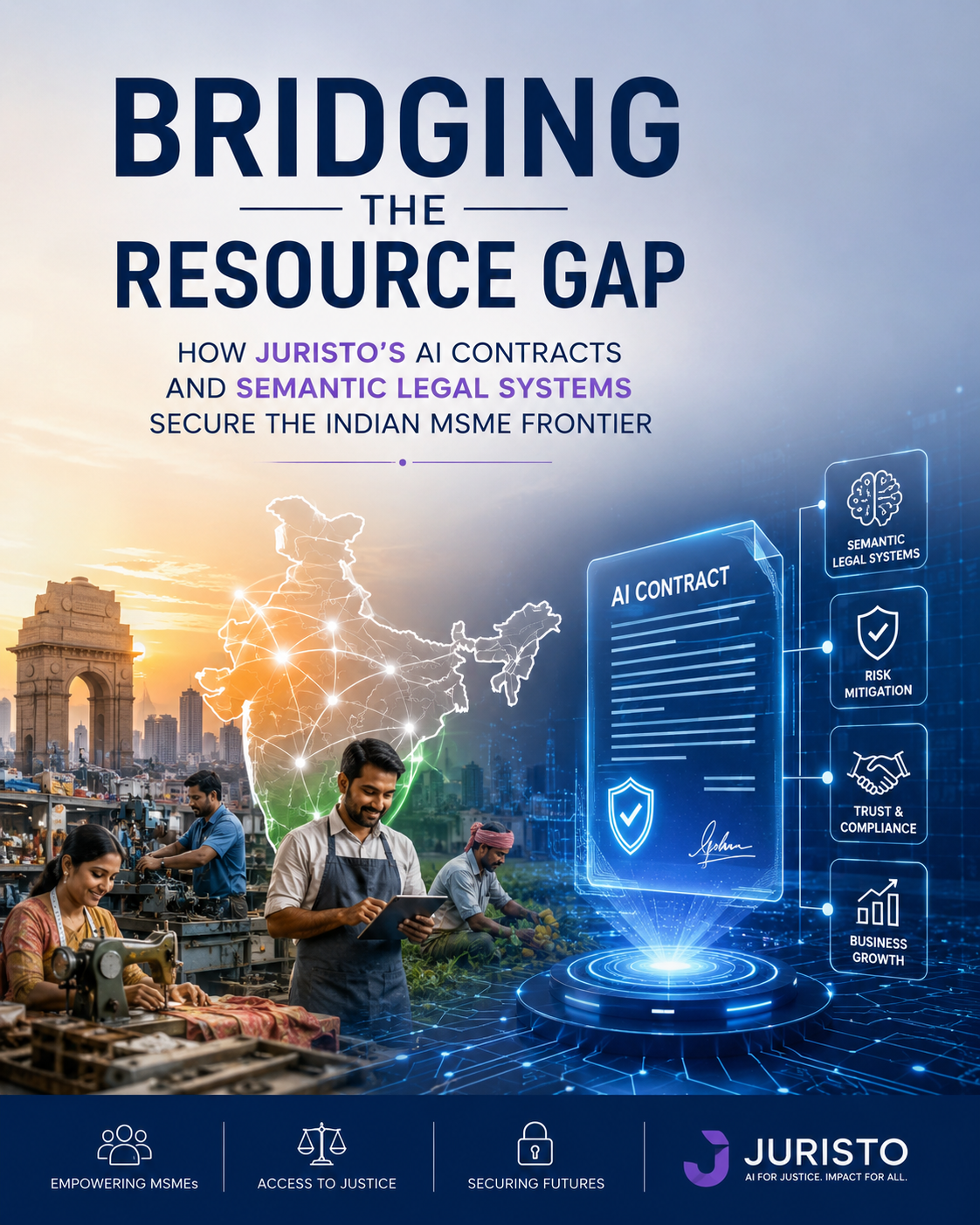
INTRODUCTION: The Silent Vulnerability of Indian MSMEs
Micro, Small, and Medium Enterprises (MSMEs) are universally acknowledged as the undisputed backbone of the Indian economy. With over 63 million MSMEs contributing to nearly a third of India's GDP and driving grassroots innovation from Bengaluru to Ludhiana, they generate the vast majority of employment outside the agricultural sector. Yet, beneath this veneer of economic resilience lies a pervasive and systemic vulnerability: the chronic reliance on informal "handshake deals," verbal agreements, and poorly drafted, generic contracts.
The core of this vulnerability is an inherent resource gap. Indian MSMEs typically lack the working capital required to retain full-time internal legal counsel or engage elite Tier-1 law firms for day-to-day operations. This absence creates a massive regulatory compliance and enforcement gap. When businesses operate without a formalized legal safety net, they expose themselves to severe information asymmetries. Larger corporate counter-parties, backed by teams of experienced corporate attorneys, often dictate predatory terms that smaller entities blindly accept simply to secure revenue. Consequently, for millions of Indian MSMEs, legal protection remains disproportionately inaccessible for many Indian MSMEs, particularly in day-to-day commercial operations, leaving their hard-earned enterprises perilously exposed to catastrophic financial liabilities.
SECTION I: The Stakes—Why Contracts are Not Disposable for Small Businesses
There is a persistent myth among small business owners in India that complex contracts are an unnecessary friction point, reserved only for multinational corporations or high-stakes litigation at the High Courts or Supreme Court. In reality, well-drafted contracts are the foundation of business stability. They are far from disposable administrative paperwork; they are strategic assets that protect a company's intellectual property, mandate clear restitutive safeguards under the Indian Contract Act, and secure predictable, stable supply chains.
Furthermore, contracts act as absolute prerequisites for institutional growth. When an Indian MSME seeks collateral-free loans under schemes like CGTMSE, or institutional venture funding, the due diligence process focuses heavily on its legal foundation. If agreements are unvouched, oral, or poorly structured, their corporate valuation plummets, and funding doors slam shut. Additionally, to leverage government recovery mechanisms like MSME Samadhaan for delayed payments, having a watertight written contract is crucial.
The Stakes are Existential
A single unfavorable clause buried in a 30-page vendor agreement can effectively cause operational or financial bankruptcy for an MSME. Examples of predatory terms include:
Ambiguous Clauses: A poorly drafted indemnity clause can shift a potential ₹50,00,000 third-party liability onto a small business for a contract worth only ₹5,00,000.
Termination for Convenience: A large corporate client can terminate the agreement at any time without assigning any reason, often with minimal notice. For an MSME, this can be financially devastating. The business may already have invested heavily in customized inventory, raw materials, logistics, staffing, and manufacturing capacity specifically for that client. Once the contract is abruptly terminated, the MSME is left with unsold stock, unpaid vendor obligations, blocked working capital, and little to no contractual remedy to recover those sunk costs.
For small enterprises operating on razor-thin margins, these aren't just administrative errors, they are fatal operational landmines. For example, a small apparel manufacturer supplying customized products to a national retail chain may unknowingly sign an agreement containing broad indemnity obligations and unilateral termination rights. If the retailer cancels the order after production begins, the MSME may absorb the entire inventory and production loss with little contractual protection.
SECTION II: The Transition from Legacy Document Builders to Juristo
Historically, legal tech for small businesses began and ended with static document builders essentially digitized filing cabinets offering standardized, "copy-paste" Word templates with fill-in-the-blank fields. While this software offered the appearance of structure, it lacked any contextual awareness. A static template downloaded from the internet does not know if the user is a SaaS startup in Hyderabad or a textile manufacturer in Surat; it cannot adapt to local state-specific Stamp Duty regulations or the specific commercial intent of the parties.
Enter the era of Semantic Law and intelligent automation, spearheaded by Juristo. Juristo is not just a document builder; it is an advanced Semantic Legal Web application built explicitly for the complexities of the Indian legal landscape. Instead of relying on static forms, Juristo uses contextual AI systems that actually understand the intricate relationships between legal concepts, Indian jurisdictional regulations, and specific business intent.
Semantic parsing allows the Juristo platform to comprehend the meaning behind a clause, rather than just identifying keywords. It knows that a "Force Majeure" clause in a logistics contract carries entirely different legal weight than one in a software licensing agreement. By transitioning toward Juristo's intelligent, contextual Legal AI, we are witnessing the dawn of accessible parity. Indian MSMEs can now leverage Juristo's automated logic engines to dynamically draft, cross-reference, and validate clauses against current statutory frameworks (like the DPDP Act or the latest GST provisions), providing a caliber of preventive legal compliance previously reserved only for Fortune 500 companies.
SECTION III: How Juristo’s AI Levels the Playing Field (Core Capabilities)
The theoretical promise of Semantic Law translates into highly practical, transformative tools for Indian MSMEs through the Juristo ecosystem. AI processes are redefining contract management across three critical operational pillars:
1. Predictive Risk Auditing: In the past, thoroughly reviewing a dense, 50-page inbound vendor agreement required a manual, multi-week contract review pipeline by external counsel, often costing anywhere between ₹50,000 and ₹2,00,000 in external legal fees depending on the complexity of the agreement. Today, Juristo's AI-driven legal systems reduce this timeline down to a few minutes of multi-clause analysis. By executing predictive risk audits, Juristo scans incoming agreements to instantly flag hidden liabilities, identify unfavorable payment terms, highlight disproportionate limitation of liability caps, and point out missing arbitration/dispute-resolution clauses.
2. Plain-Language Demystification: Traditional legalese is intentionally dense, often acting as a structural barrier to entry for non-lawyer founders. Juristo's advanced Natural Language Processing (NLP) models dismantle this barrier through plain-language demystification. This empowers MSME owners to negotiate confidently without waiting on costly external counsel translations.
3. Automated Lifecycles & Compliance: Contracts are not static documents meant to be signed and forgotten; they are living charts of ongoing obligations. Juristo introduces automated lifecycle management to track these obligations proactively. This active layer of compliance avoids unwanted automatic rollovers of expensive software subscriptions, protects intellectual property expirations, ensures proper stamp duty execution across different Indian states, and guarantees that the MSME always stands on a rock-solid foundation regarding its legal commitments.
The Hybrid Advantage: Juristo AI Labs
Recognizing that technology is most potent when paired with human expertise, Juristo is launching Juristo AI Labs. This hybrid initiative features an expansive, rapidly growing marketplace designed to connect MSMEs directly with verified, highly qualified lawyers across India. This ecosystem ensures that when a transaction demands complex human negotiation or specific litigation strategy, small businesses have seamless, affordable access to trusted advocates who utilize Juristo’s backend tech to deliver lightning-fast, cost-effective results.
CONCLUSION: The Future of Democratized Justice with Juristo
The advent of Semantic Legal Systems and Juristo's AI-assisted contracting does not signal the obsolescence of the human attorney. The strategic nuance, empathetic counseling, and complex negotiation skills of seasoned Indian legal professionals remain entirely irreplaceable. However, what Juristo successfully accomplishes is the deployment of a crucial frontline shield against exploitation for the most vulnerable sectors of Indian commerce.
By bridging the massive resource gap, Juristo is rewriting the traditional rules of commercial engagement in India. It ensures that the validity of an enterprise's rights is not dictated by the depth of its pockets or its ability to afford elite legal fees. As we move forward, Juristo is shifting legal security from an exclusionary corporate luxury to a baseline operational asset. For the millions of Indian MSMEs charting the economic frontier, the empowerment provided by intelligent, contextual legal tech is not just an upgrade in efficiency—it is the ultimate democratization of commercial justice.
Protect your business and start your journey towards legal resilience today by exploring Juristo's intelligent contract solutions at juristo.in.