

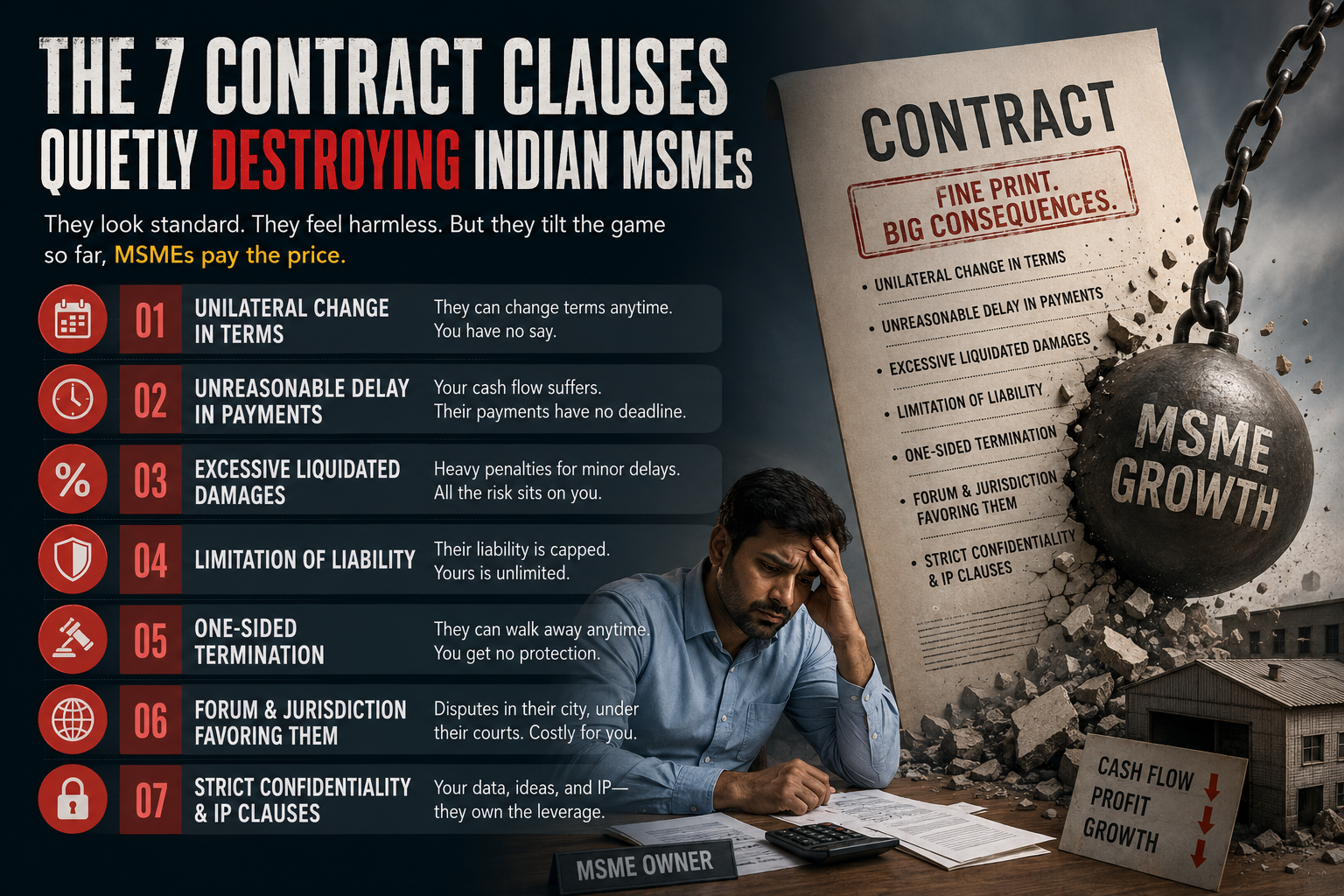
Executive Summary
For most Indian MSMEs, growth usually begins with a major client. A large purchase order, a long-term supply arrangement, or a corporate partnership often feels like a breakthrough moment for the business. In the rush to secure that opportunity, contracts are frequently treated as a formality.
That is where the problem begins.
Many MSMEs sign vendor agreements drafted entirely by large buyers without fully reviewing the commercial implications hidden inside standard clauses. At first glance, the agreement may look routine. But buried within these contracts are provisions that quietly transfer financial and operational risk almost entirely onto the smaller business.
The damage is rarely immediate. It appears gradually through delayed payments, one-sided penalties, open-ended liabilities, unfair termination rights, and pricing structures that become impossible to sustain over time.
Over the past year, discussions around MSME protections have increased significantly, especially after the introduction of Section 43B(h) of the Income Tax Act. At the same time, more businesses are beginning to use technology platforms such as Juristo (https://juristo.in/) to review contracts early and identify commercially risky clauses before signing them.
This article examines seven contract clauses that continue to place Indian MSMEs in vulnerable positions despite existing statutory protections.
1. Extended Payment Cycles Beyond the Statutory Limit
Delayed payment clauses are probably the most common issue faced by MSMEs today.
Many vendor agreements still provide payment timelines extending to 90 or even 120 days, usually tied to internal approvals, reconciliation processes, or audit clearances. For a large company, this may simply be an accounting cycle. For an MSME, it directly affects salaries, inventory purchases, rent, logistics, and day-to-day survival.
In practical terms, the MSME ends up financing the buyer’s business operations while simultaneously borrowing money to keep its own operations running.
This is precisely why Section 15 of the MSMED Act, 2006 imposes a statutory limit on payment timelines. Payments to registered Micro and Small Enterprises must be made within 15 days where no written agreement exists and within a maximum of 45 days where there is a written agreement.
The introduction of Section 43B(h) has strengthened this framework further by disallowing tax deductions for buyers who fail to clear dues within the prescribed timeline.
Yet many businesses still sign agreements containing payment clauses that effectively defeat these protections because the issue is not spotted during review. Increasingly, MSMEs are using platforms such as Juristo to review procurement contracts and identify problematic payment structures before execution.
2. Unlimited Liability and Consequential Damages
Another clause that quietly creates enormous risk for MSMEs is the unlimited liability provision.
Many contracts require the vendor to indemnify the buyer against “all losses,” including indirect or consequential damages. Most founders do not realise how broad this language actually is until a dispute arises.
A delayed delivery or operational issue can suddenly escalate into claims involving alleged business interruption losses, reputational harm, downstream penalties, or lost profits. Even if the claims are exaggerated, defending them itself becomes financially draining for a smaller business.
What makes these clauses particularly unfair is that they are rarely balanced. The buyer’s liability is often heavily restricted, while the MSME assumes open-ended exposure.
In reality, no small business should be taking unlimited commercial risk for a contract that may only represent a fraction of that exposure in revenue.
This is where careful contract review becomes essential. Tools such as Juristo are increasingly helping businesses identify one-sided indemnity structures and uncapped liability clauses early, before they become future litigation problems.
3. Punitive Liquidated Damages Clauses
Liquidated damages clauses are not inherently unreasonable. Buyers are entitled to protection where delays genuinely affect operations.
The problem is that many procurement agreements impose penalties that are commercially disproportionate and entirely one-sided.
Supply chains are unpredictable. Delays can occur because of logistics disruptions, shortages, approval delays, raw material fluctuations, or external market conditions. Yet contracts often allow buyers to deduct penalties immediately from invoices without examining whether the delay was actually within the MSME’s control.
For businesses operating on thin margins, these deductions can wipe out profitability on the entire project.
Fair contracts should contain reasonable caps, grace periods, and reciprocal obligations where buyer-side delays contribute to performance issues. Unfortunately, that balance is often missing in standard procurement documentation.
4. Distant Arbitration Seats and Cost-Prohibitive Dispute Resolution
Many MSMEs discover another problem only after disputes arise: the arbitration clause.
Large companies routinely specify Mumbai, Delhi, or other commercial centres as the exclusive seat of arbitration regardless of where the MSME operates. On paper, this may appear procedural. In practice, it becomes a major financial barrier.
For a small business pursuing unpaid dues of ₹10–15 lakhs, the costs of travel, legal representation, arbitration fees, and repeated hearings can become commercially irrational. As a result, many MSMEs simply abandon legitimate claims.
The MSMED Act does offer protection through the Micro and Small Enterprises Facilitation Council (MSEFC) mechanism, which allows registered MSMEs to pursue delayed payment claims despite contrary arbitration clauses in private contracts.
The issue is not always absence of legal protection. Often, it is lack of awareness.
5. Overbroad Intellectual Property Transfer Clauses
For technology and manufacturing-focused MSMEs, intellectual property clauses can create long-term damage if not reviewed carefully.
Many agreements contain broad “work for hire” language stating that all intellectual property created during the engagement belongs exclusively to the buyer. The wording often goes much further than the specific deliverable being purchased.
A software company may unintentionally transfer ownership over internal tools, reusable code libraries, templates, or proprietary systems developed over years. Engineering and manufacturing firms face similar risks with designs, methods, and technical workflows.
The distinction between background IP and project-specific deliverables is critical, yet it is frequently ignored in standard-form contracts.
Over time, this can erode the MSME’s own competitive advantage.
6. Unilateral Termination for Convenience
Large contracts often require MSMEs to make significant upfront investments. Businesses may hire additional staff, purchase inventory, expand warehouse capacity, or enter long-term vendor commitments based on expected continuity of work.
Yet many agreements allow buyers to terminate the contract “for convenience” without establishing any breach and without compensating the vendor for resulting losses.
When this happens, the MSME is left carrying stranded inventory, operational costs, and unpaid commitments with little practical recourse.
Termination clauses are necessary in commercial relationships, but unrestricted termination rights that shift all financial consequences onto the smaller party create obvious imbalance.
7. Fixed Pricing Without Escalation Protection
Long-term fixed-price contracts can also become dangerous during periods of inflation or market volatility.
An agreement that appears commercially workable at the time of signing may become financially unsustainable if fuel costs, labor expenses, freight charges, or raw material prices rise sharply over time.
Many MSMEs continue performance despite mounting losses because breaching the contract may trigger penalties or damage commercial relationships.
Reasonable escalation mechanisms linked to objective benchmarks such as WPI or commodity indices are increasingly important in long-duration supply agreements. Without them, the entire burden of market fluctuation falls on the vendor.
Conclusion
Most MSME failures are not caused by a single catastrophic event. More often, financial stress builds slowly through delayed receivables, unbalanced liabilities, pricing pressure, and contractual terms that transfer disproportionate risk onto the smaller business.
The law does provide certain protections through the MSMED Act, Section 43B(h), and the MSEFC dispute framework. But legal protection is only useful if businesses are able to identify problematic clauses before disputes arise.
That is why contract review is no longer something MSMEs can afford to ignore.
Platforms such as Juristo are becoming useful for businesses that may not have in-house legal teams but still want an initial understanding of contractual risk before signing procurement agreements. While technology cannot replace legal advice in complex matters, it can help businesses identify red flags early and approach negotiations with greater clarity.
Ultimately, contracts decide who absorbs financial pain when commercial relationships become difficult. MSMEs that understand this — and review agreements carefully — place themselves in a far stronger position to protect cash flow, reduce avoidable disputes, and build sustainable long-term business relationships.