

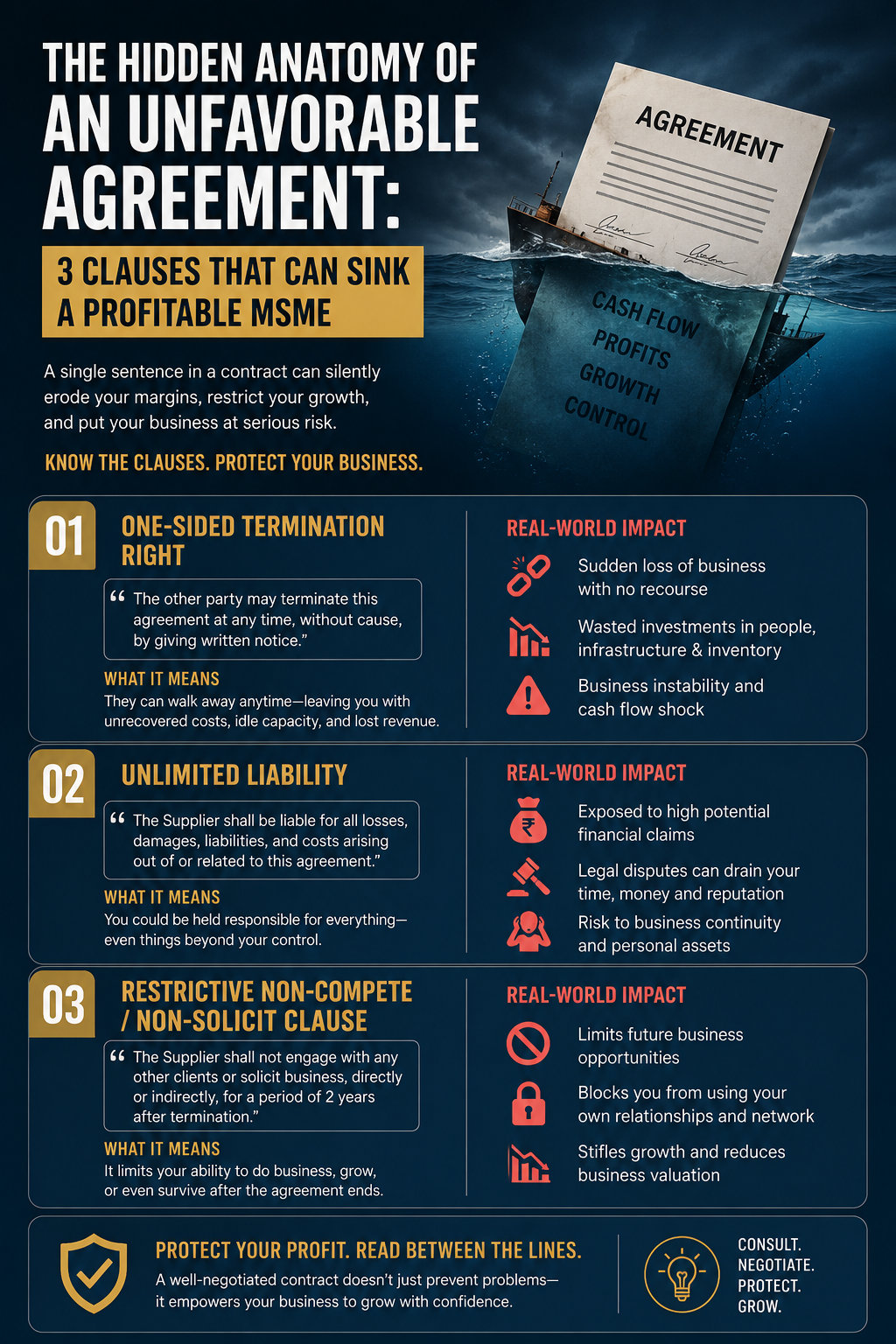
Most MSME owners spend significant time negotiating prices, delivery timelines, payment schedules, and commercial expectations. Yet when the final agreement arrives, many skim through the legal provisions and sign. The assumption is simple: if the business terms are favorable, the contract must be as well. Unfortunately, that assumption has cost many businesses far more than a failed negotiation ever could.
The reality is that contracts are not merely records of commercial understanding. They are documents that allocate risk. Hidden within seemingly standard legal language are provisions that can determine who bears losses, who can walk away from the relationship, and who remains liable when things go wrong. For MSMEs operating on tight margins, overlooking these clauses can transform a profitable transaction into a costly lesson.
1. Termination for Convenience Clause
One of the most dangerous clauses for an MSME is a termination-for-convenience provision. This clause allows one party to end the contract without proving any breach or fault. While it may appear harmless during negotiations, its consequences can be severe.
Consider a marketing agency that signs a ₹10 lakh annual service contract and hires additional employees to service the client. Six months later, the client exercises its termination-for-convenience right and exits the agreement with 30 days' notice. The agency is left with salary commitments, onboarding expenses, and lost revenue that may not be recoverable. The contract itself may have been profitable on paper, but the termination clause shifts the commercial risk almost entirely onto the service provider.
For MSMEs that invest in inventory, manpower, infrastructure, or project-specific resources, such provisions can create significant financial exposure long before any dispute arises.
2. Indemnity Clause
If termination clauses threaten future revenue, indemnity clauses can threaten the business itself. An indemnity provision determines who bears financial responsibility when claims, losses, or legal proceedings arise. Many MSMEs treat this language as standard boilerplate without appreciating the scale of risk it can create.
Imagine a software startup entering into a ₹5 lakh service agreement. Buried within the contract is a broadly worded indemnity clause with no cap on liability. A dispute later results in a third-party claim, and the startup finds itself defending allegations worth ₹50 lakh. Whether the claim ultimately succeeds may be irrelevant—the legal costs and potential exposure can be substantial.
The danger becomes even greater when indemnity obligations extend to indirect, consequential, or third-party losses. A business expecting to earn a few lakhs from a contract may unknowingly assume liabilities worth several times the contract value. By the time the risk becomes visible, renegotiation is usually no longer an option.
3. Automatic Renewal Clause
Automatic renewal clauses are rarely discussed during negotiations because they do not appear threatening at the outset. However, they frequently trap businesses in obligations they no longer want.
Consider an MSME that signs a one-year software subscription agreement worth ₹2 lakh. The contract states that it will automatically renew for another year unless notice is provided 60 days before expiry. Focused on daily operations, the business misses the deadline and becomes liable for another year's fees despite planning to switch vendors.
The financial impact may not seem dramatic in isolation, but when multiple vendor contracts, service agreements, and commercial arrangements contain similar provisions, unwanted renewals can quietly drain resources. The problem is not merely the renewal itself—it is that many businesses do not realize the contract has renewed until after the opportunity to exit has passed.
The challenge is that these clauses are rarely highlighted during negotiations. They are often buried deep within lengthy agreements and drafted in dense legal language. For MSMEs without dedicated legal teams, identifying and understanding these risks can be difficult. This is where legal technology platforms such as Juristo can provide practical value. By helping businesses review contracts, identify potentially unfavorable provisions, and understand risk allocation before signing, such tools make it easier to spot issues that might otherwise remain hidden until they become expensive problems.
The good news is that many of these risks can be identified before execution. A few extra minutes spent reviewing key provisions can prevent months or even years of financial and legal complications.
Quick Contract Checklist
Before signing any agreement, ask yourself:
Can the other party terminate the contract without compensating me?
Is my liability capped at a reasonable amount?
Does the contract contain broad indemnity obligations?
Will the agreement automatically renew if I miss a notice deadline?
Have I clearly understood the risks hidden beyond the commercial terms?
Contracts are often viewed as legal formalities that follow a business deal. In reality, they are risk-allocation tools that determine what happens when a business relationship stops being perfect. The price, scope, and payment terms may define the opportunity, but the legal clauses determine who bears the consequences when things go wrong. For MSMEs, success is not just about securing profitable contracts, it is about ensuring that the risks embedded within those contracts do not outweigh the profits they promise.