
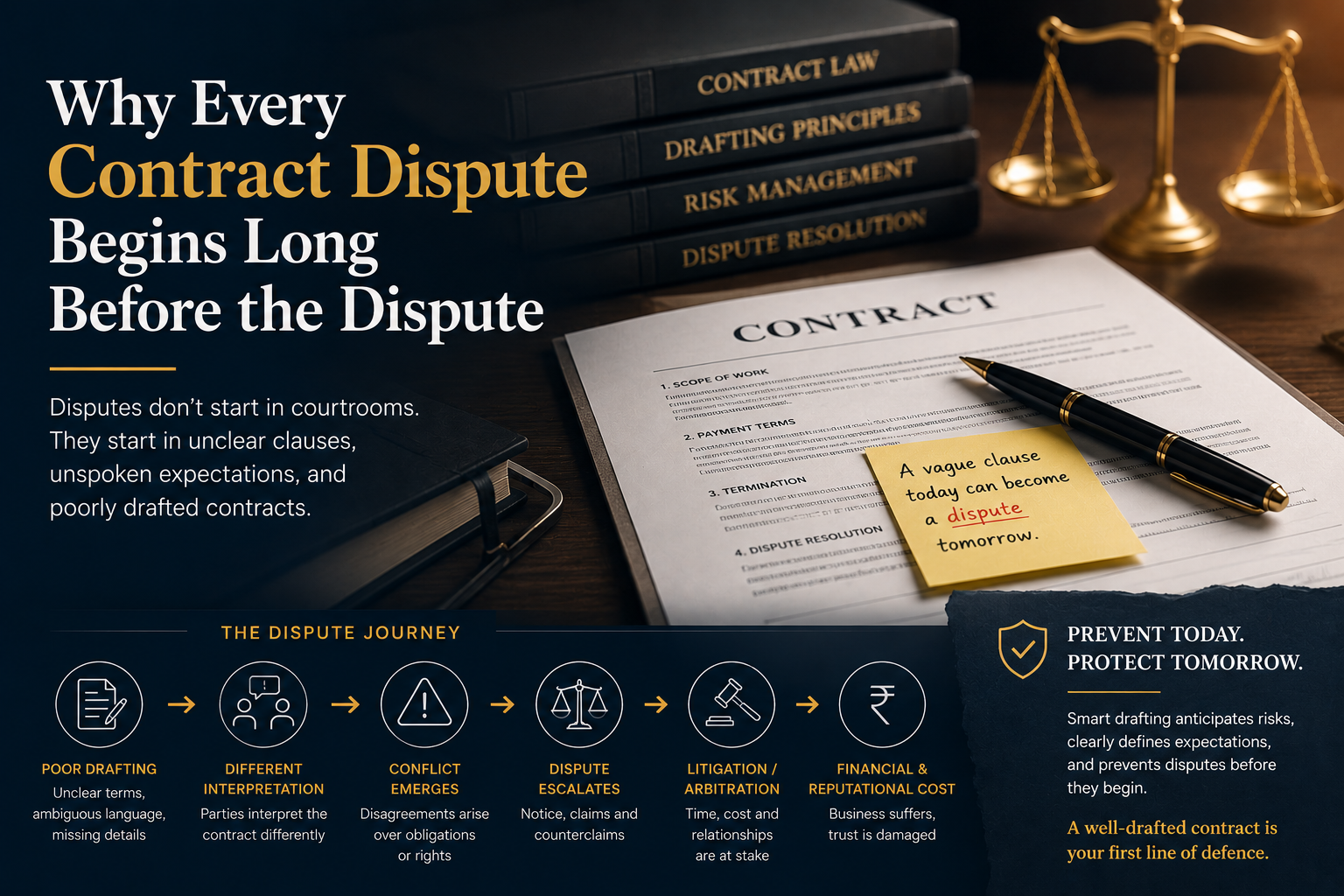
When businesses think about legal disputes, they often imagine courtrooms, lawyers arguing before judges, and lengthy litigation proceedings. In reality, most contract disputes begin much earlier often at the drafting stage.
A vague clause, an undefined obligation, an unclear payment term, or an overlooked risk allocation mechanism can create problems that remain hidden until the relationship between parties breaks down. By the time a dispute reaches a courtroom or arbitration tribunal, the damage has usually already been done.
The Cost of Poor Drafting
Many businesses treat contracts as formalities rather than risk-management tools. Standard templates are copied from previous transactions, clauses are inserted without understanding their implications, and negotiations focus primarily on commercial terms. This approach can be costly.
Consider a simple service agreement. If the scope of services is poorly defined, parties may have entirely different expectations regarding performance obligations. Similarly, if termination rights are ambiguous, one party may believe it can exit the agreement freely while the other believes otherwise.
The resulting dispute is often not about bad faith. It is about bad drafting.
Precision Creates Protection
Good drafting is not about making documents longer. It is about making them clearer.
Effective contracts answer important questions before they arise:
What exactly must each party do?
When must obligations be performed?
What happens if performance is delayed?
Who bears specific risks?
How will disputes be resolved?
The clearer the answers, the lower the likelihood of future conflict.
Experienced lawyers understand that every clause serves a purpose. A limitation of liability clause allocates risk. A force majeure clause addresses uncertainty. A dispute resolution clause determines how disagreements will be handled.
Drafting is therefore not merely documentation, it is preventive law.
The Challenge Facing Modern Lawyers
Today's lawyers face a different challenge than previous generations.
The volume of information has increased dramatically. New judgments, regulatory developments, industry-specific requirements, and evolving commercial practices require constant attention.
As a result, drafting a high-quality agreement involves more than legal knowledge. It requires efficient research, careful document review, and the ability to identify risks quickly.
This is one reason why legal technology has gained significant importance in recent years.
Technology as a Drafting Partner
Artificial Intelligence is increasingly being used to support legal professionals during the drafting process.
Rather than replacing legal judgment, AI tools can help lawyers review documents, analyse clauses, identify inconsistencies, and organise legal research more efficiently.
The goal is not automation for its own sake. The goal is to reduce time spent on repetitive tasks so that lawyers can focus on strategic decision-making.
Platforms such as Juristo reflect this shift. By assisting with legal research, document analysis, and drafting workflows, such tools allow lawyers to spend less time searching for information and more time applying their expertise where it matters most.
Prevention Is Better Than Litigation
Clients often approach lawyers after a dispute has already emerged. However, the greatest legal value is often delivered before any dispute occurs.
A carefully drafted agreement may never receive public attention. It may never be tested in court. Yet it can save businesses substantial costs, preserve commercial relationships, and prevent years of uncertainty.
In that sense, the best legal work is often invisible.
Conclusion
Contract disputes rarely begin when a notice is issued or a case is filed. More often, they begin with unclear language, overlooked risks, and inadequate drafting.
As commercial relationships become increasingly complex, the ability to draft clearly and strategically will remain one of the most valuable skills in legal practice. Combined with modern legal technology that enhances research and drafting efficiency, lawyers are better equipped than ever to prevent disputes before they arise.
The future of legal practice will belong not only to those who know the law, but also to those who can communicate it effectively through well-crafted legal documents.